Battery Engineering Blog
Discover expert perspectives, custom battery design guides, charging solutions, and industry updates from USA engineers.
High-Performance Emergency Battery Modules & Kits
Explore our certified emergency lighting power conversion modules, designed for T5/T8 LED tubes, architectural panel lights, exit signs, and heavy-duty industrial luminaires.
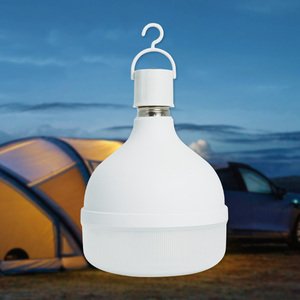
Engineered for dual-use applications including emergency blackout backup, outdoor camping, and night fishing. Features automatic grid-fail transfer circuit and high-efficiency lithium driver.
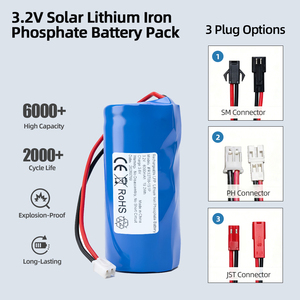
Custom-designed LiFePO4 battery pack integrated with intelligent PCM/BMS hardware. Offers deep-cycle stability for solar emergency streetlights and indoor emergency backup kits.
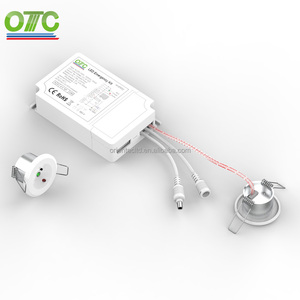
Slim profile emergency power supply designed specifically for commercial LED ceiling panel lights and troffers. Features self-diagnostic testing routine and automatic cut-off logic.
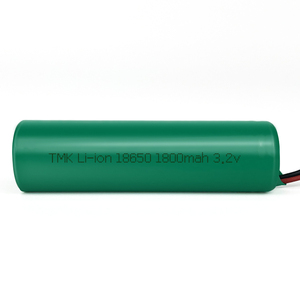
Heavy-duty cylindrical 18650 cell cluster with certified fire-retardant sleeving. Fully compliant with IEC62133, IEC62620, and UN38.3 transport safety regulations for global delivery.
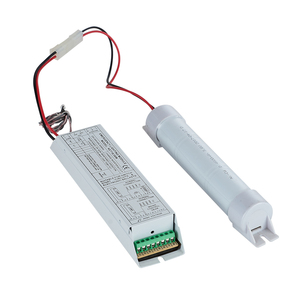
Wholesale retrofitting driver module designed to convert standard Linear T8 fluorescent or T8 LED tubes into code-compliant emergency fixtures without changing existing ballast wiring.
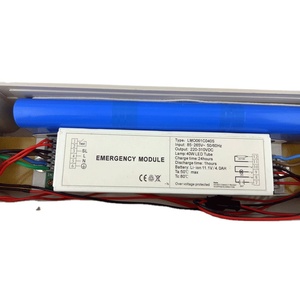
Weatherproof outdoor emergency inverter kit designed for high-bay LED lights, tri-proof fixtures, and damp location industrial task lights requiring 100% lumen retention during outages.
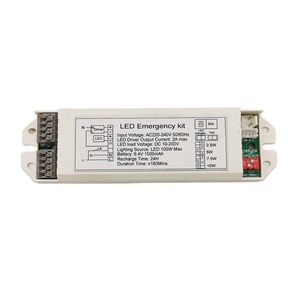
Compact emergency conversion module featuring automated trickle charging, tri-color LED status indicators, and integrated test switch. Compatible with external DC dimmable LED drivers.
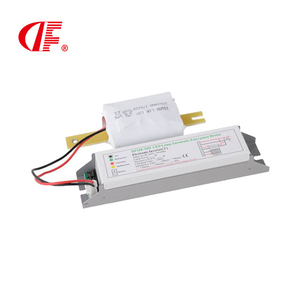
Ultra-thin rectangle profile aluminum casing engineered to fit narrow luminaire channels. Provides 1.5 hours of emergency backup power using premium lithium iron phosphate technology.
Emergency Lighting Battery Modules: Architecture, Chemistry & Life Safety Codes
Executive Summary & Regulatory Framework
Emergency lighting battery modules serve as the critical last line of defense in life safety systems across commercial, industrial, and institutional infrastructure. When main AC power fails during fires, natural disasters, or grid blackouts, emergency lighting drivers instantly transition to internal DC battery power, supplying mandatory emergency illumination along egress paths, stairwells, exit corridors, and hazardous work zones.
International safety codes—such as NFPA 101 (Life Safety Code) in North America, EN 60598-2-22 in the European Union, and BS 5266-1 in the UK—mandate that emergency lighting modules deliver a minimum of 90 to 180 minutes of continuous illumination at specified foot-candle or lux levels. Achieving compliance requires OEMs and procurement managers to evaluate cell chemistry, thermal stability, Battery Management System (BMS) logic, and conversion driver efficiency.
Cell Chemistry Comparison Matrix for Emergency Backup Drivers
A detailed comparison of traditional nickel-based chemistry vs. modern high-density Lithium Iron Phosphate (LiFePO4) and Ternary Lithium cells used in B2B emergency conversion modules.
| Battery Chemistry | Energy Density (Wh/kg) | Cycle Life (80% DOD) | Operating Temp Range | Self-Discharge Rate | Thermal Safety Profile | Global Regulatory Preference |
|---|---|---|---|---|---|---|
| LiFePO4 (LFP) | 140 - 180 Wh/kg | 2,500 - 4,000 Cycles | -10°C to +60°C | < 2% / Month | Ultra-High (No Thermal Runaway <270°C) | Primary Choice (Modern Standard) |
| Ni-MH (High-Temp) | 60 - 90 Wh/kg | 500 - 800 Cycles | 0°C to +50°C | 15% - 20% / Month | Moderate (Requires Continuous Trickle) | Legacy Replacement |
| Ni-Cd (Nickel-Cadmium) | 45 - 60 Wh/kg | 500 - 1,000 Cycles | -20°C to +55°C | 10% - 15% / Month | High Risk (Toxic Heavy Metal RoHS Restrict) | Phased Out Globally |
| NMC Lithium-Ion | 200 - 250 Wh/kg | 800 - 1,200 Cycles | -20°C to +50°C | < 3% / Month | Requires Strict BMS Thermal Protection | Specialized Compact Packs |
Top 5 Future Sourcing Trends in Emergency Battery Modules (2025–2030)
1. Paradigm Shift to Smart LiFePO4 Chemistry
Global regulatory bodies are accelerating the phase-out of Nickel-Cadmium due to RoHS environmental mandates. Lithium Iron Phosphate (LiFePO4) has emerged as the dominant chemical standard due to its 10+ year service life, zero toxic heavy metals, and superior thermal tolerance in ceiling plenum environments.
2. DALI-2 & Wireless Self-Testing Automation
Modern building specifications demand smart emergency modules supporting DALI-2 (IEC 62386-202) and wireless mesh protocols (Zigbee/Bluetooth LE). Automated emergency drivers conduct monthly discharge testing and report cell status directly to facility management dashboards without manual labor.
3. Ultra-Slim Form Factors & Integrated Drivers
As commercial luminaire designs become increasingly minimalist, OEM fixture manufacturers require miniaturized emergency power packs. Rectangular profile aluminum enclosures with heights under 21mm enable seamless installation into narrow LED linear channels and ultra-thin panel backplates.
4. Constant-Power vs. Constant-Current Output Logic
Leading engineering specs are shifting from constant-current drivers to Constant-Power Emergency Drivers. Constant-power technology automatically adjusts the output voltage according to the connected LED array (10V-90V DC), guaranteeing predictable lumen output throughout the full 90-minute discharge cycle.
5. Strict Global Transport Certification Compliance
International freight regulations for lithium battery exports have intensified. Top-tier manufacturers must provide full test summary reports for UN38.3, IEC 62133-2, UL 924, and MSDS to ensure smooth customs clearance and compliance for air and maritime shipping.
World-Class OEM/ODM Battery Manufacturing Capabilities
Over 40 Years of Battery Engineering Excellence
Founded in 1983, our manufacturing enterprise has established a global reputation as a single-source OEM partner for smart battery packs, emergency lighting power supplies, and custom battery chargers. Serving blue-chip clients across North America, Europe, and Asia, our facilities bridge state-of-the-art battery assembly with rigorous quality control standards.
Whether your application requires custom LiFePO4 cell matching, specialized IP65 waterproof housings, custom PCB/BMS layout, or compliance certification under UL924 and IEC62133 standards, our engineering team works directly alongside your product designers from early prototyping to high-volume assembly.
Custom Smart BMS Development
In-house hardware and software engineering for custom Protection Circuit Modules (PCM) offering over-voltage, deep discharge, short circuit, and high-temp cut-offs.
ISO 9001 Certified Quality
100% automated cell grading, internal resistance sorting, and load bank discharge testing guarantee zero-defect manufacturing for critical safety hardware.
Global Certification Support
Complete regulatory compliance assistance. We provide test documentation for UL 924, CE, IEC 62133-2, UN38.3, and RoHS to simplify global distribution.
Agile Lead Times & Export Logistics
Flexible order volumes from small prototyping batches to full container shipments. Dedicated export packing and dangerous goods (DG) logistics management.
Frequently Asked Questions (FAQ) for B2B Sourcing
What is the difference between constant power and constant current emergency drivers?
A constant current emergency driver delivers a fixed output current, which causes the emergency wattage and light output to vary depending on the connected LED forward voltage. Conversely, a constant power emergency module automatically adjusts its output voltage to maintain a fixed wattage (e.g., 8W or 12W) across any connected load between DC 10V and 90V. This ensures precise, consistent emergency illumination that satisfies NFPA 101 and EN 60598-2-22 code calculations.
Why is LiFePO4 preferred over traditional Ni-Cd for emergency lighting battery packs?
LiFePO4 (Lithium Iron Phosphate) offers significant performance and compliance advantages: higher energy density (allowing 70% smaller size), extended service life (up to 10 years compared to 2-3 years for Ni-Cd), superior thermal safety (no thermal runaway up to 270°C), and zero toxic heavy metals, making it fully compliant with RoHS and REACH global environmental regulations.
How does the auto-test (self-diagnostic) function work in emergency battery modules?
Smart emergency modules feature an integrated microcontroller unit (MCU) that performs automated testing according to international standards. The module executes a 30-second monthly functional test and a full 90-minute annual duration test automatically. If the BMS detects a cell failure, charger anomaly, or capacity degradation below legal thresholds, the multi-color LED indicator alerts facility managers.
What certifications are required for exporting emergency lighting battery modules to Europe and North America?
For North America, emergency modules must comply with UL 924 (Emergency Lighting and Power Equipment) and carry UN38.3 transport certification for lithium batteries. For the European market, modules require CE, EN 60598-2-22, EN 61347-2-7, and battery cell certification under IEC 62133-2.
Can emergency conversion modules be retrofitted into existing LED panel lights and linear troffers?
Yes. Universal emergency conversion kits are engineered to sit wired between the main AC supply, the standard LED driver, and the LED array. When AC mains are live, the module passes power through to the normal driver while keeping the battery fully charged. Upon AC power loss, the internal relay instantly switches the LED array to receive emergency power directly from the battery pack.
What is the typical lifespan and shelf life of an emergency lighting LiFePO4 battery pack?
Quality LiFePO4 emergency battery packs designed with smart BMS trickle-charging protection achieve a service life of 6 to 10 years under normal ambient operating temperatures (0°C to +50°C). Due to a low self-discharge rate (< 2% per month), packs can be stored for up to 6 months prior to installation without permanent capacity loss, provided they are stored in a dry, cool environment.
What customization options (OEM/ODM) are available for emergency driver modules?
As a direct manufacturer, we provide end-to-end customization including custom output wattage/voltage ranges, custom enclosure dimensions (ultra-slim aluminum or high-impact polycarbonate), IP ratings (IP20 to IP65), wiring harness lengths, custom branding/labeling, and integrated DALI-2 smart lighting control protocols.
Request Custom Sample & Wholesale Pricing
Partner with an industry-leading OEM/ODM emergency battery module manufacturer. Submit your project requirements, target specifications, or luminaire drawings for immediate engineering support.
Get a Quote