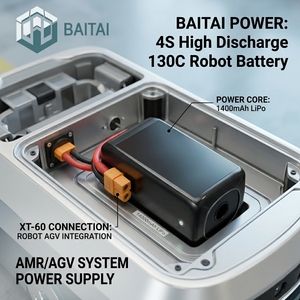
130C 1400mAh 4S High Discharge LiPo Battery for Service Robot AGV
Ultra-high discharge lithium polymer assembly delivering peak current response for dynamic AMR mobility, fast actuation, and high-burst service robotics payloads.
Discover expert perspectives, custom battery design guides, charging solutions, and industry updates from USA engineers.
Engineered with custom smart BMS, high C-rate capability, extreme thermal endurance, and long cycle life for continuous 24/7 autonomous material handling operations.
Ultra-high discharge lithium polymer assembly delivering peak current response for dynamic AMR mobility, fast actuation, and high-burst service robotics payloads.
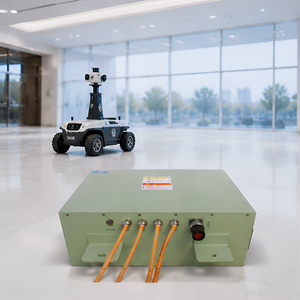
Heavy-duty industrial platform power module. Features integrated active balance Smart BMS, deep cycle durability (4000+ cycles), and rapid opportunity charging support.
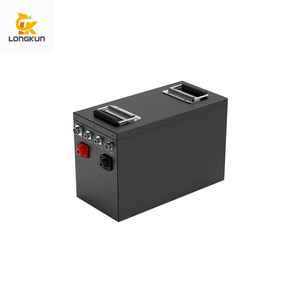
Standardized 24V warehouse AGV battery system. Optimized for narrow-aisle autonomous mobile robots requiring stable continuous discharge and long operational shifts.
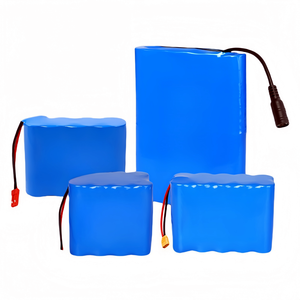
Highly customizable cylindrical lithium battery pack series engineered for commercial floor-cleaning robots, disinfection AMRs, and compact logistics bots.
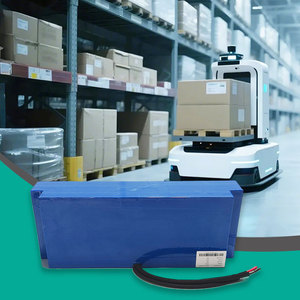
Next-gen LTO technology offering ultra-fast 10-minute charging, super-long 20,000-cycle life, and extreme safety in cold-chain logistics warehouses.
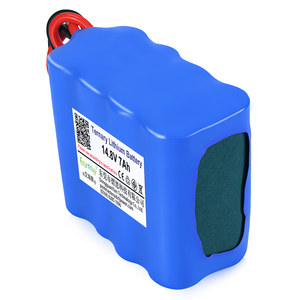
High energy density NMC battery assembly for lightweight outdoor autonomous mowers, electric wheelchairs, and inspection mobile robot platforms.
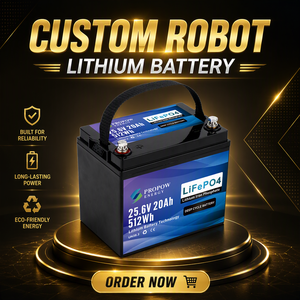
Ruggedized industrial LiFePO4 battery pack equipped with short-circuit, over-current, and thermal shock protection for heavy-load factory AGVs.
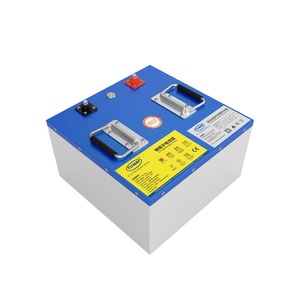
Heavy-duty power system for forklift AGVs and heavy autonomous movers. Engineered for extreme ambient working temperatures with integrated heating pads.
In modern Industry 4.0 automated logistics, warehouse fulfillment centers, and smart manufacturing plants, Automated Guided Vehicles (AGVs) and Autonomous Mobile Robots (AMRs) serve as the foundational backbone for material handling. As global enterprises transition from legacy lead-acid batteries to advanced lithium-ion chemistries, selecting the right battery pack manufacturer in China becomes a pivotal strategic decision for Original Equipment Manufacturers (OEMs) and system integrators.
This technical whitepaper provides an engineering-grade evaluation of custom lithium battery pack assemblies, examining cell chemistries—including Lithium Iron Phosphate (LiFePO4), Nickel Manganese Cobalt (NMC), Lithium Titanate (LTO), and High-Discharge Lithium Polymer (LiPo)—alongside smart Battery Management System (BMS) communications, thermal dynamics, fast opportunity charging, and total cost of ownership (TCO) optimization.
Unlike standard electric vehicle (EV) batteries that undergo single daily charge-discharge cycles, industrial AGVs operate on dynamic duty cycles. Modern AGVs utilize Opportunity Charging (1C to 5C rates) during brief 5-to-15 minute station idle periods. This requires cell assemblies with ultra-low internal resistance (IR < 0.8mΩ per cell) and active cell-balancing BMS architectures to prevent localized thermal runaway and capacity imbalance over multi-shift operational years.
Electrifying autonomous mobile platforms requires evaluating spatial constraints, payload requirements, charge rates, ambient working environments, and safety protocols. Below is an engineering benchmark comparison of the four primary lithium chemistries supplied by leading Chinese custom battery manufacturers:
| Battery Chemistry | Nominal Cell Voltage | Cycle Life (80% DOD) | Continuous / Peak C-Rate | Energy Density (Wh/kg) | Thermal Stability Threshold | Optimal AGV / AMR Application |
|---|---|---|---|---|---|---|
| LiFePO4 (LFP) | 3.2 V | 3,500 - 6,000 | 1C / 3C | 140 - 175 Wh/kg | > 270°C (Ultra Safe) | Heavy-duty warehouse AGVs, forklift platforms, 24/7 industrial bots |
| NMC (Nickel Manganese Cobalt) | 3.6 V - 3.7 V | 1,500 - 2,500 | 2C / 5C | 200 - 260 Wh/kg | ~ 210°C | Compact AMRs, inspection robots, payload-constrained mobile units |
| LTO (Lithium Titanate) | 2.3 V - 2.4 V | 15,000 - 25,000 | 10C / 20C (Ultra Fast) | 80 - 110 Wh/kg | > 300°C (Non-Combustible) | Cold-chain storage AMRs (-30°C), continuous automated docking fleets |
| LiPo (Lithium Polymer) | 3.7 V | 500 - 1,000 | 50C / 130C Burst | 180 - 220 Wh/kg | ~ 150°C | High-agility service robots, robotic arms, rapid acceleration actuators |
A lithium battery assembly without an intelligent battery management system is a liability in safety-critical automated factories. Modern B2B procurement demands integrated Smart BMS boards capable of real-time telemetry, precise State of Charge (SOC) tracking using Coulomb counting algorithms, and State of Health (SOH) diagnostics.
Direct communication with AGV central controllers via CANopen, SAE J1939, RS485 Modbus RTU, or SMBus protocols. Allows seamless transmission of voltage, current, temperature, and fault flags to central Fleet Management Systems (FMS).
Unlike passive balancing that dissipates excess energy as heat through resistors, advanced active balancing transfers energy from higher-voltage cells to lower-voltage cells during both charge and discharge cycles, extending pack runtime by up to 15%.
Embedded high-precision NTC thermistors continuously map temperature gradients across individual cell parallel groups, power MOSFETs, and busbars, instantly isolating contactors if internal temperatures exceed safety parameters (>60°C).
Procurement directors and chief technology officers evaluating Chinese lithium battery manufacturers must align their product roadmaps with five critical emerging technological shifts:
1. Automated Contactless Inductive Charging & Pantograph Docking: Modern logistics hubs are phasing out manual plug-in charging in favor of autonomous contactless magnetic induction and high-current copper pantograph pads. Battery packs must accept pulse charge surges without voltage spike tripping.
2. Modular Hot-Swappable Battery Architectures: To eliminate charging downtime entirely, heavy material handling AGVs are adopting modular dual-bay hot-swappable battery enclosures with automatic blind-mate connectors and soft-start pre-charge circuits.
3. Semi-Solid State Cell Integration: As semi-solid-state lithium cells reach commercial maturity in China, high-density AMRs will achieve 300+ Wh/kg while eliminating flammable liquid electrolytes, elevating safety in hazardous chemical and aerospace manufacturing plants.
4. Total Cost of Ownership (TCO) Shift to LTO Chemistry: While LTO batteries require higher upfront capital expenditure, their 20,000-cycle life translates to over 10 years of continuous operation without battery replacement, reducing lifetime cost-per-hour by up to 60% compared to standard lithium-ion packs.
5. European Battery Regulation & Global Passport Compliance: Global buyers require Chinese suppliers to provide full material traceability, carbon footprint documentation, UN38.3 transport safety reports, CE marking, and compliance with the EU Battery Regulation (2023/1542).
For a fleet of 50 warehouse AGVs operating 3 shifts daily over 5 years: Lead-acid batteries require 2 replacement sets per robot plus dedicated watering maintenance ($180,000 operational expense). Transitioning to Custom LiFePO4 Packs with 1C Opportunity Charging eliminates battery swapping infrastructure, recovers 2.5 hours of uptime per AGV daily, and yields a net ROI payback in under 11 months.
Combining over 40 years of battery design legacy with state-of-the-art Chinese manufacturing scale, rigorous quality controls, and custom engineering capabilities.
100% sorting of tier-1 cells (CATL, EVE, BYD, Panasonic) using automated voltage, capacity, and internal resistance matching (< 2mV voltage delta, < 0.5mΩ IR delta) before assembly.
Automated nickel busbar laser welding eliminates cold solder joints and minimizes electrical resistance, ensuring zero pack-level hot spots under continuous high current load.
Custom laser-cut steel, extruded aluminum, or vibration-damping ABS/PC enclosures engineered to withstand severe industrial drops, dust, water washdowns, and structural shocks.
Pre-tested and certified to international standards including UN38.3 transport safety, MSDS, CE, IEC 62133, UL 2580, UL 2271, and RoHS compliance for seamless global export.
Technical guidance and answers for OEM procurement managers, robotics engineers, and industrial supply chain directors.
Consult with our senior battery engineers today to review your electrical schematics, BMS requirements, and custom enclosure specifications. Get a tailored OEM quotation within 24 hours.
Send an Inquiry