Battery Engineering Blog
Discover expert perspectives, custom battery design guides, charging solutions, and industry updates from USA engineers.
Architectural Blueprint of Turnkey Energy Storage Systems (BESS)
Analyzing Cell-to-Grid Systems Integration, Multi-Tier BMS Topology, Thermal Runaway Mitigation, and Smart Grid Synchronization.
In the current landscape of global energy transition, industrial-scale battery energy storage systems (BESS) and mobile robot platform batteries have evolved beyond basic electrochemistry. Modern turnkey energy storage solutions represent complex electromechanical systems requiring tight synchronization across chemical cell selection, battery management systems (BMS), dynamic cooling, energy management software (EMS), and high-efficiency power conversion systems (PCS).
As a primary China energy storage solutions supplier, our engineering frameworks integrate high-density Lithium Iron Phosphate (LiFePO4), Lithium Titanate (LTO), Nickel Manganese Cobalt (NMC), and high-discharge Lithium Polymer (LiPo) chemistries into custom industrial enclosures, commercial platform units, and autonomous mobile robot (AGV/AMR) power platforms.
High C-Rate Cell Selection
From standard 1C grid peak-shaving modules to extreme 130C surge discharge packs for autonomous mobile platforms, our automated cell matching ensures internal resistance variance remains within ≤0.5mΩ.
Smart Multi-Layer BMS
Embedded microcontrollers perform real-time SOC, SOH, and SOE calculations. Integrated short-circuit, over-charge, over-discharge, and active cell-balancing logic protect against battery thermal runaway.
Thermal & Enclosure Design
Custom aluminum structural framing, liquid-cooling cold plates, phase-change insulation, and IP67 industrial sealing withstand heavy shocks, vibrations, and sub-zero operational environments (-20°C to 60°C).
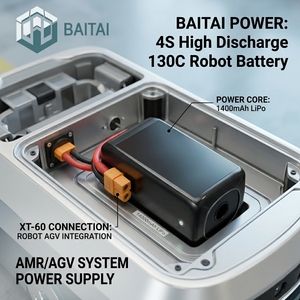
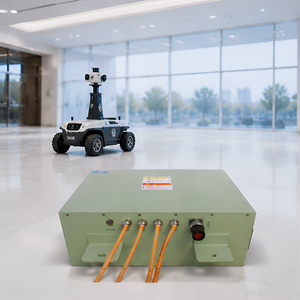
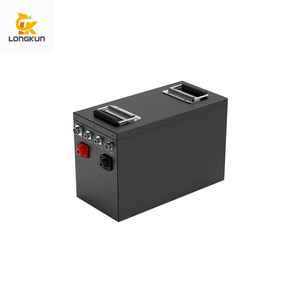
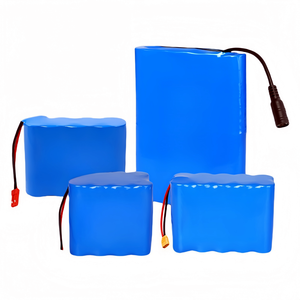
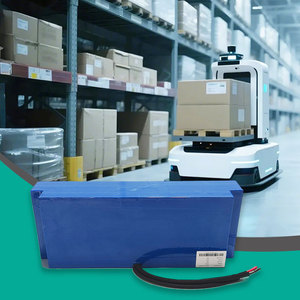
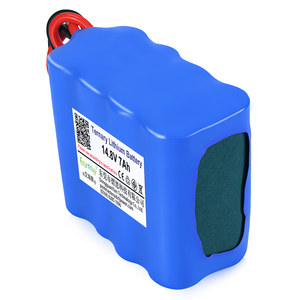
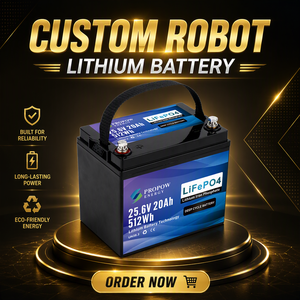
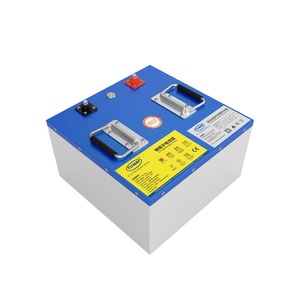
Featured Industrial & AMR Energy Storage Battery Solutions
High-performance battery systems customized for AGV/AMR robotics, medical mobility, floor cleaning equipment, and stationary turnkey energy systems.
Technical Comparison of Energy Storage Chemistries
Evaluating LiFePO4, LTO, NMC, and LiPo for turn-key BESS and mobile robotics applications.
| Performance Metric | LiFePO4 (LFP) | Lithium Titanate (LTO) | NMC (Lithium Cobalt) | High-Discharge LiPo |
|---|---|---|---|---|
| Nominal Cell Voltage | 3.2 V | 2.3 V | 3.6 V - 3.7 V | 3.7 V |
| Gravimetric Energy Density | 140 - 180 Wh/kg | 70 - 110 Wh/kg | 200 - 260 Wh/kg | 180 - 220 Wh/kg |
| Cycle Life (80% DOD) | 3,500 - 6,000 Cycles | 15,000 - 25,000 Cycles | 1,200 - 2,000 Cycles | 500 - 1,000 Cycles |
| Max Discharge C-Rate | 1C - 3C Continuous | 5C - 10C Continuous | 2C - 5C Continuous | 50C - 130C Pulse |
| Fast Charging Capability | 1C (1 Hour) | 6C - 10C (6-10 Mins) | 1C (1 Hour) | 2C - 5C (15-30 Mins) |
| Thermal Runaway Temp | 270°C (Extremely Safe) | >300°C (Highest Safety) | 210°C (Moderate) | 150°C (Requires BMS Monitoring) |
| Primary Application | Container BESS / Industrial AMR | 24/7 Heavy AGVs / Ultra-Fast Docking | Compact Devices / E-mobility | High Surge Service Robots / Drones |
Future Procurement & Development Trends in Turnkey Energy Storage
Key Insights for Global OEM Engineers, Sourcing Directors, and Grid Infrastructure Procurement Managers.
1. Vertical Supply Chain Consolidation in China
Global BESS buyers are shifting procurement strategies from individual component sourcing toward integrated turnkey manufacturers in China. Sourcing complete assemblies—housing cells, active balancing BMS, inverter interfacing, and thermal management within a single supply contract—drastically reduces operational risk and guarantees system-level UL 9540 and IEC 62619 compliance.
2. LTO & Sodium-Ion Commercial Acceleration
While LiFePO4 maintains a dominant market share for stationary utility-scale BESS due to its balance of energy density and cost, Lithium Titanate (LTO) and emerging Sodium-Ion chemistries are capturing industrial AMR automated manufacturing fleets. The ability of LTO to withstand 10C charging rates allows 24/7 continuous warehouse automated platforms to recharge during 5-minute opportunistic docking windows.
3. Cloud-Connected Smart BMS & AI-EMS Integration
Future procurement criteria mandate remote telematics. Modern BMS units now embed IoT modules offering real-time cloud data transmission via CANbus, Modbus-TCP, and MQTT protocols. Machine learning algorithms analyze cell telemetry to predict cell degradation, dynamically recalibrate state-of-charge (SOC), and prevent thermal anomalies before critical failure.
Why Partner With Us As Your Turnkey BESS Manufacturer
Leveraging Over Four Decades of Battery Engineering & Custom Pack Assembly Excellence.
40+ Years Engineering Heritage
Originally established with deep roots in custom battery pack fabrication, our engineering team brings unmatched expertise across lithium, nickel, and complex power control designs.
Automated Cell Matching & Welding
Our production facilities utilize automated laser welding machines, high-precision cell grading channels, and IR resistance sorting to eliminate cell imbalance in large battery configurations.
Single-Source OEM/ODM Customization
We handle every step: custom CAD mechanical enclosure design, PCB BMS hardware layout, custom firmware development, thermal simulation, and full-stack assembly under one roof.
Strict Global Certifications Compliance
Our quality management systems are ISO 9001 and ISO 14001 certified. Products undergo rigorous UN 38.3, UL 1642, UL 1973, UL 9540A, CE, and IEC 62133 safety validation before export.
Frequently Asked Questions (FAQ)
Direct engineering insights answering key buyer, technical standard, and custom ordering queries.
A turnkey solution encompasses the entire energy system lifecycle: customized battery cell selection, custom pack structural assembly, integrated BMS hardware/firmware, thermal management systems (air or liquid cooling), power conversion (PCS inverters), fire suppression systems, and communication gateways pre-tested and integrated inside a single plug-and-play enclosure ready for immediate deployment.
Selection depends on operational duty cycles. LiFePO4 is chosen for standard shift robots requiring high energy density and 3,500+ cycles at lower upfront costs. LTO (Lithium Titanate) is specified for 24/7 continuous automated fleets requiring sub-10 minute ultra-fast charging and 20,000+ cycle life. NMC is preferred when mechanical space is extremely constrained and high gravimetric energy density is paramount.
Our custom BMS hardware incorporates hardware and software level protections against over-voltage, under-voltage, continuous over-current, peak short-circuit (response within <100 microseconds), high/low temperature cut-off, individual cell voltage passive/active balancing, and CANbus/RS485 communication telemetry for system diagnostic monitoring.
Standard prototype engineering samples typically require 2 to 4 weeks depending on enclosure complexity and certification requirements. Minimum order quantities for custom OEM battery packs range from 10 to 50 units for specialized industrial platforms, up to full container loads for standardized BESS modules.
For cold-chain warehouse AMRs and outdoor BESS installations operating down to -20°C or -40°C, we incorporate low-temperature electrolyte formulations combined with internal BMS-controlled heating films. The heating system utilizes incoming charge current to warm the cell matrix to safe charging thresholds before allowing charge current to flow.
All export battery shipments are fully compliant with UN 38.3 transport safety regulations, including altitude simulation, thermal testing, vibration, shock, external short circuit, impact, overcharge, and forced discharge reports. Dangerous Goods (DG) packaging, Class 9 labeling, MSDS sheets, and sea/air freight certification are provided with every order.
Initiate Your Custom Energy Storage Project
Consult directly with our engineering team to receive customized battery cell recommendations, BMS schematics, and competitive factory-direct pricing.