Executive Whitepaper: Strategic Procurement & Engineering Standards for CE Certified Solar Energy Storage & Industrial Battery Systems
As the global energy landscape transitions aggressively toward decentralized microgrids and autonomous industrial automation, global procurement teams, system integrators, and OEM engineers face stringent demands regarding battery storage performance, regulatory compliance, and thermal safety. Selecting a qualified CE Certified Solar Energy Storage Battery Solutions Manufacturer & Factory is no longer merely a commercial sourcing decision—it is a core engineering partnership that impacts systemic downtime, Total Cost of Ownership (TCO), and operational safety across commercial, industrial, and robotic applications.
This technical guide provides comprehensive insights into battery chemistry selection, Smart Battery Management System (BMS) telemetry, thermal runaway prevention architecture, and European CE regulatory verification (specifically referencing EN IEC 62619, EN 61000-6-2/4 EMC standards, and UN38.3 transport safety).
Information Gain Insight: Beyond Basic Battery Capacity
While traditional procurement metrics focus heavily on initial amp-hour (Ah) cost, modern industrial and solar storage systems evaluate Levelized Cost of Storage (LCOS). High-performance LiFePO4 and Lithium Titanate (LTO) chemistries engineered with active cell-balancing BMS reduce localized thermal stress, extending real-world operational service life from 5 years to over 15 years.
Comparative Analysis of Industrial Battery Chemistries for BESS and Robotics
Selecting the optimal electrochemical pair requires evaluating specific trade-offs among gravimetric energy density, volumetric efficiency, operating thermal range, and high-rate discharge tolerance. Below is an engineering comparison of the primary chemistries deployed by tier-1 manufacturers:
| Battery Chemistry | Nominal Cell Voltage | Cycle Life (80% DoD) | C-Rate Capability | Thermal Runaway Threshold | Primary Industrial Applications |
|---|---|---|---|---|---|
| LiFePO4 (LFP) | 3.2 V | 4,000 – 6,000+ | 1C continuous / 3C peak | ~270°C (Extremely Safe) | Solar Storage, Heavy AGVs, Stationary BESS |
| NMC (Nickel Manganese Cobalt) | 3.6 V – 3.7 V | 1,500 – 2,500 | 3C continuous / 10C peak | ~210°C (Requires Active Cooling) | Portable Robotics, Drones, Compact AMRs |
| LTO (Lithium Titanate) | 2.3 V | 20,000 – 30,000 | 10C continuous / 30C fast-charge | >300°C (Ultra-Safe) | 24/7 Automated Warehouses, Extreme Low Temp |
| Sodium-Ion (Na-Ion) | 3.0 V – 3.1 V | 2,000 – 4,000 | 2C continuous / 5C peak | ~260°C (High Stability) | Grid Energy Storage, Low-Cost Telecommunications |
Smart BMS Telemetry & Safety Architecture in OEM Manufacturing
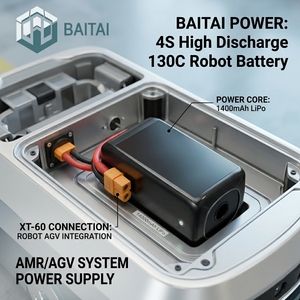
A reliable solar storage or industrial robot battery pack relies fundamentally on its integrated Smart Battery Management System (BMS). Modern CE-certified manufacturing facilities integrate multi-tiered BMS control units equipped with real-time CANbus (CANopen/J1939), RS485, and Modbus communication protocols.
Active Cell Balancing
Unlike passive balancing that wastes energy as heat, active inductive/capacitive balancing transfers energy between adjacent cells, ensuring less than 5mV voltage delta across 100% state of charge (SoC).
Thermal Management
Multi-point NTC thermistor monitoring provides real-time heat map tracking. Built-in thermal cutoffs auto-isolate battery banks if temperatures exceed safe limits during high-rate discharge.
Overcurrent & Short Safety
Dual-stage hardware short-circuit protection triggers solid-state MOSFET isolation in under 100 microseconds, guarding sensitive inverter components against voltage spikes.
Future Procurement & Industry Growth Trends (2025–2030)
Global demand for reliable stationary solar BESS and mobile autonomous robot power packs is driving several critical technological shifts in procurement strategy:
1. Shift Toward LTO Fast-Charging in Industrial AGVs
Modern logistics and warehouse operations are moving away from traditional overnight charging regimens. LTO (Lithium Titanate) batteries enable 10C to 15C continuous fast charging, allowing automated guided vehicles to fully recharge in 6 to 10 minutes during automatic opportunity charging breaks, enabling 24/7 continuous facility operations.
2. Stringent Verification of CE & IEC Standards for EU/North America Imports
Importers must look beyond basic self-declaration marks. True CE Compliance for Energy Storage Batteries requires independent laboratory validation under EN IEC 62619 (industrial lithium safety) and EN 61000-6-2/4 (Electromagnetic Compatibility), alongside mandatory UN38.3 transport safety documentation.
3. Integration of Cloud Battery Analytics & Predictive Maintenance
Modern solar battery systems feature IoT gateway integration, allowing facility engineers to remotely track State of Health (SoH), internal impedance rise, and cell degradation curves in real-time, preventing unexpected system outages before they occur.