Battery Engineering Blog
Discover expert perspectives, custom battery design guides, charging solutions, and industry updates from USA engineers.
2026 Best Robotics Battery Packs for Global Buyers?
Table of Contents
- Robotics Battery Packs: Definition, Functions, and Core Components
- Key Battery Technologies Used in Modern Robotic Systems
- How to Evaluate Capacity, Voltage, Safety, and Operating Life
- Battery Pack Selection for Different Robot Types and Applications
- Global Buying Factors: Standards, Suppliers, Costs, and Logistics
- FAQS
- Conclusion
- Related Posts
Choosing the best robotics battery packs in 2026 requires more than comparing capacity or advertised runtime. A mobile robot may cross a warehouse floor, climb a ramp, or stop repeatedly beside charging equipment. Each task changes the battery’s real demands. This guide examines lithium-ion, LiFePO4, and emerging solid-state options through practical factors, including energy density, cycle life, charging speed, thermal control, battery management systems, and serviceability.
Jeff Dahn, a leading battery researcher, has described the battery as “the heart of the electric vehicle.” The same principle applies to robotics. A weak pack can limit motor performance, shorten operating hours, and create avoidable maintenance delays. A well-matched pack supports stable voltage, predictable discharge, and safer daily operation. Small details matter. Connector quality matters. Cooling paths matter. Even a dusty charging bay can expose a design weakness.
Global buyers also need evidence, not impressive packaging. We compare test data, operating temperature ranges, protection features, certification claims, warranty terms, and supplier support. Regional shipping conditions and local service access receive attention too. No battery wins every application. A lightweight inspection robot may favor high energy density, while an autonomous warehouse vehicle may need long cycle life and easy replacement. Some published figures remain difficult to verify. That is worth admitting. Real-world performance can differ from laboratory results. This 2026 overview therefore helps buyers question specifications, identify trade-offs, and select robotics battery packs suited to their robots, work environments, and long-term operating costs.
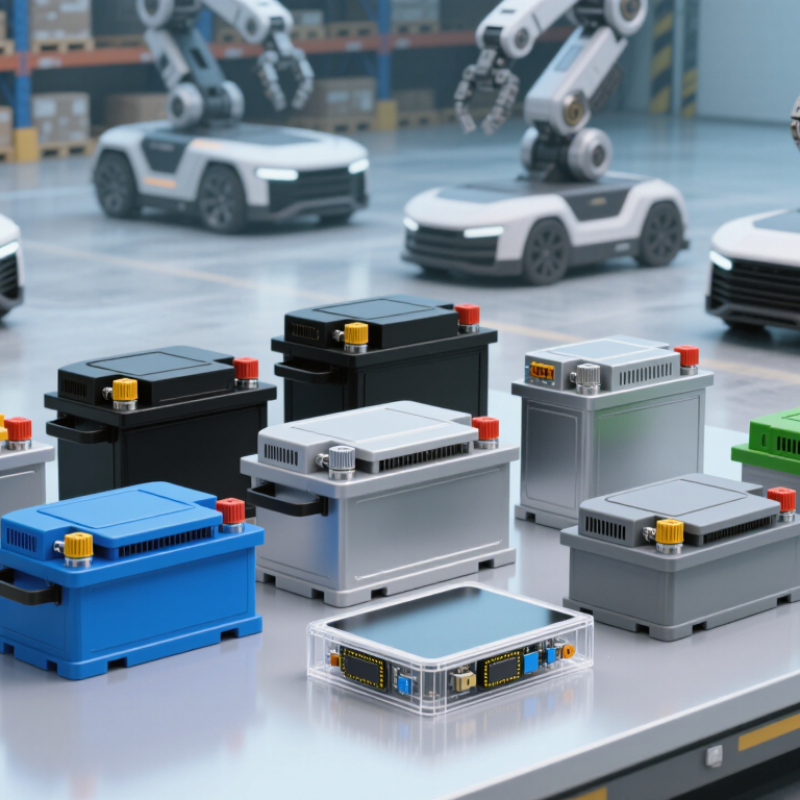
Robotics Battery Packs: Definition, Functions, and Core Components
A robotics battery pack is an engineered energy unit designed for automated machines. It stores electrical energy and releases it according to the robot’s operating demands. Unlike ordinary consumer batteries, it must handle vibration, repeated charging, sudden power loads, and changing temperatures. In mobile robots, the pack affects travel distance, lifting strength, response speed, and working time. That choice matters.
Its main function is to provide stable power to motors, sensors, controllers, and communication systems. It must deliver high current during movement without excessive voltage drop. A pack also supports monitoring, charging control, thermal protection, and emergency shutdown. Core components usually include battery cells, a battery management system, housing, wiring, connectors, fuses, and temperature sensors. Cells determine energy capacity. The management system tracks voltage, current, temperature, and charging balance. The housing protects internal parts from dust, impact, and moisture. Small details matter.
For global buyers in 2026, evaluation should include cycle life, usable capacity, charging time, weight, safety testing, and service documentation. Numbers can mislead. Actual performance depends on payload, floor conditions, speed, and duty cycles. A lighter pack may improve mobility but reduce operating time. A larger pack may extend runtime while increasing motor stress. I would request test records under conditions close to real work, not only laboratory figures. Field trials may expose connector heating or inaccurate battery estimates. Pilot testing is still necessary.
Key Battery Technologies Used in Modern Robotic Systems
Modern robotic systems depend on battery chemistry, thermal design, and control software working together. Lithium-ion remains dominant because it combines useful energy density with rechargeable performance. The International Energy Agency reported that lithium iron phosphate batteries held more than 40% of the global electric vehicle battery market in 2023. That trend matters to robotics buyers seeking safer, lower-cost packs for warehouse vehicles, inspection robots, and mobile platforms.
Lithium nickel manganese cobalt cells can deliver strong energy density, helping aerial and compact robots operate longer. Lithium iron phosphate cells usually provide better thermal stability and long cycle life, but they may add weight. Lithium-polymer packs offer flexible shapes for small machines. Supercapacitors can support short power bursts, especially during climbing or rapid acceleration. Solid-state batteries remain promising, yet manufacturing maturity and supply consistency still require careful review.
Battery management systems are not optional. They monitor cell voltage, temperature, current, and balancing during every mission. The International Federation of Robotics recorded 541,302 industrial robot installations in 2023, showing why reliable power systems now support large-scale automation. Buyers should request tested cycle-life data, cold-start performance, ingress protection, and transport documentation. A spreadsheet can still mislead. Real robots face vibration, dust, sudden loads, and imperfect charging habits. One overlooked connector can stop an entire work shift.
| Battery Technology | Typical Nominal Cell Voltage | Typical Pack-Level Energy Density | Typical Cycle Life to 80% Capacity | Power Capability | Thermal and Safety Profile | Best-Fit Robotic Applications | Key Buying Considerations |
|---|---|---|---|---|---|---|---|
| Lithium Iron Phosphate (LFP) | Approximately 3.2 V per cell | Approximately 90–160 Wh/kg | Approximately 2,000–6,000 cycles | High; suitable for frequent acceleration, regenerative braking, and high-duty operation | Strong thermal stability and lower risk of thermal runaway than many nickel-rich lithium-ion chemistries; generally tolerant of repeated deep cycling | Autonomous mobile robots, warehouse vehicles, service robots, agricultural robots, and industrial platforms requiring long service life | Good safety-to-cost balance and widely available raw materials; heavier than higher-energy lithium-ion alternatives |
| Nickel Manganese Cobalt (NMC) | Approximately 3.6–3.7 V per cell | Approximately 140–220 Wh/kg | Approximately 1,000–2,500 cycles | High to very high, depending on cell design and cooling system | High energy storage in a compact package, but requires qualified battery management, mechanical protection, temperature monitoring, and suitable charging controls | Humanoid robots, inspection robots, drones, portable medical robots, and systems where low mass and long runtime are priorities | Offers a strong energy-density advantage; buyers should evaluate thermal design, transport compliance, warranty limits, and replacement cost |
| Nickel Cobalt Aluminum (NCA) | Approximately 3.6–3.7 V per cell | Approximately 160–240 Wh/kg | Approximately 800–2,000 cycles | Very high energy and power capability when paired with appropriate cooling and controls | Requires careful thermal management, overcharge protection, cell balancing, and enclosure design; higher energy density increases the importance of fault containment | High-mobility robots, aerial systems, advanced inspection platforms, and weight-sensitive mobile machines | Useful where mass is more important than maximum cycle life; pack certification and thermal monitoring are essential for global deployment |
| Lithium Titanate (LTO) | Approximately 2.3–2.4 V per cell | Approximately 50–100 Wh/kg | Approximately 5,000–20,000 cycles | Extremely high charge and discharge capability; supports rapid opportunity charging | Excellent low-temperature performance, strong thermal stability, and low degradation under high-current operation | Fast-charging mobile robots, automated guided vehicles, port equipment, logistics systems, and robots operating in cold environments | Very long operating life and rapid charging, but larger and heavier packs may be required for the same stored energy |
| Lithium Manganese Oxide (LMO) | Approximately 3.7–4.0 V per cell | Approximately 90–150 Wh/kg | Approximately 500–1,500 cycles | High power output with good short-duration acceleration capability | Generally safer than some high-nickel chemistries, although elevated temperature and repeated high-current operation can accelerate capacity loss | Power tools, compact robots, medical equipment, and hybrid battery packs that combine power-focused and energy-focused cell chemistries | Suitable for applications needing strong power response; confirm expected operating temperature and replacement-cycle economics |
| Lithium Polymer | Approximately 3.7 V per cell | Approximately 120–200 Wh/kg | Approximately 300–1,000 cycles | Very high peak power and flexible form-factor options | Requires strict protection against overcharge, puncture, swelling, compression, and overheating; pouch cells need appropriate mechanical support | Small aerial robots, collaborative prototypes, lightweight research robots, and compact systems with demanding peak-power requirements | Enables thin or custom-shaped packs; buyers should prioritize enclosure design, swelling allowance, storage procedures, and qualified charging systems |
| Sodium-Ion | Approximately 2.8–3.3 V per cell | Approximately 80–160 Wh/kg | Approximately 1,000–3,000 cycles | Moderate to high, depending on electrode and cell design | Can provide good low-temperature performance and avoids dependence on lithium, nickel, and cobalt; pack-level safety still depends on cell and management-system design | Stationary charging docks, low-speed logistics robots, indoor service robots, and cost-sensitive platforms with moderate runtime demands | Potentially attractive for supply-chain diversification and cost control; verify production availability, pack qualification, charger compatibility, and energy density |
| Values are typical commercial ranges and vary by cell format, electrode design, pack architecture, operating temperature, discharge rate, charging strategy, and battery-management-system settings. For global procurement, also verify UN 38.3 transport testing, IEC 62133 or applicable regional safety requirements, electromagnetic compatibility, ingress protection, local recycling obligations, charger compatibility, and the supplier’s documented service and replacement plan. | |||||||
How to Evaluate Capacity, Voltage, Safety, and Operating Life
Capacity is more than a number printed on a battery label. Estimate the robot’s average current, peak current, mission duration, and conversion losses. A 10 Ah pack may not deliver 10 Ah during heavy acceleration or cold operation. Measure real consumption during lifting, turning, and standby periods. I have found that laboratory estimates often look optimistic. Field logs usually tell a different story.
Voltage must match the motor controller, sensors, and charging system. Check the pack’s nominal voltage, full-charge voltage, and low-voltage cutoff. A small mismatch can cause resets, overheating, or permanent equipment damage. Safety depends on cell quality, battery management, insulation, thermal control, and fault protection. Look for documented test results and traceable production records. Operating life also depends on depth of discharge, charging speed, storage temperature, and vibration. Even a well-designed pack can age quickly when repeatedly drained to its limit.
Tips: Keep a 20–30% energy reserve for unexpected resistance or route changes. Test the battery inside the finished robot, not only on a workbench. Record temperature, voltage sag, charge cycles, and runtime. Replace assumptions with measurements. Also, do not ignore transport and regional compliance requirements; documentation may vary between markets.
Battery Pack Selection for Different Robot Types and Applications
2026 Best Robotics Battery Packs for Global Buyers?
Battery Pack Selection for Different Robot Types and Applications
A warehouse AGV needs predictable runtime, fast charging, and strong cycle life. Its battery pack should match motor peaks, not only average power. A lithium iron phosphate pack often suits fleets that operate for long shifts. It offers useful thermal stability and a long service life. However, its weight can reduce payload efficiency. This trade-off deserves measurement.
A delivery robot faces curbs, vibration, rain, and frequent stop-start movement. Choose a sealed pack with a reliable battery management system and clear fault reporting. Check voltage tolerance before connecting the pack to drive controllers. Small details matter. A connector that loosens under vibration can stop an entire route.
Drones and inspection robots usually prioritize low weight and high discharge capability. Their packs need accurate state-of-charge data, balanced cells, and controlled charging. Cold environments can reduce available energy sharply. Thermal monitoring becomes essential. For robotic arms, peak current may matter more than long endurance. A compact pack can work well when the arm returns to a fixed charger.
Global buyers should verify transport documentation, enclosure ratings, charging compatibility, and local service support. Test the pack with the real robot, loaded and unloaded. Laboratory results may not reflect dusty floors or steep ramps. I have seen runtime estimates fail because standby consumption was ignored. That mistake is easy to repeat. Reliable selection requires field data, not attractive specifications alone.
2026 Best Robotics Battery Packs for Global Buyers
Battery pack selection by robot type and typical application
Typical battery energy varies with payload, operating hours, terrain, speed, duty cycle, and onboard computing requirements. Lightweight mobile robots generally use compact 0.2–1.0 kWh packs, while autonomous mobile robots and delivery platforms commonly require approximately 1.0–4.0 kWh. Heavy-duty industrial and outdoor robots may need 4.0–12.0 kWh or more. Actual pack sizing should include a reserve margin and the manufacturer’s voltage, thermal, and safety requirements.
Values shown are representative engineering ranges for common robot applications, not brand-specific product specifications.
Global Buying Factors: Standards, Suppliers, Costs, and Logistics
2026 Best Robotics Battery Packs for Global Buyers?
For global robotics buyers, battery selection starts with standards, not advertised capacity. Check cell safety reports, transport test records, ingress protection, and electromagnetic compatibility documents. Confirm the exact pack model matches every certificate. A similar-looking replacement may not qualify. Ask for test dates, laboratory names, and traceable serial records. Documentation can reveal more than a product page.
Supplier evaluation needs practical evidence. Request sample packs, cycle-life data, thermal behavior, and a written warranty. Test a pack during charging, sudden movement, and low-temperature startup. Measure voltage sag under the robot’s real load. Cheap samples often hide costly weaknesses. Still, laboratory results are not field truth. Your floor, duty cycle, and maintenance habits can change performance.
Cost planning should include cells, battery management systems, chargers, tooling, inspection, duties, insurance, and replacement stock. Logistics also matter. Battery shipments require correct classification, protective packaging, labels, and carrier acceptance. Confirm delivery routes before placing a large order. A local warehouse may reduce downtime, while consolidated sea freight may lower unit cost. Air freight is faster, but restrictions and surcharges can change quickly. Build a small buffer. It may feel inefficient, yet one delayed pack can stop an entire robotic cell.
FAQS
They offer useful energy density and rechargeable performance. They suit warehouse vehicles, inspection robots, and mobile platforms. No battery is perfect.
High-energy cells can help small and aerial robots operate longer. They may increase thermal-management demands. Test them under real flight or movement loads.
They usually provide strong thermal stability and long cycle life. Their main drawback is added weight. That extra weight matters during climbing.
Their flexible shapes suit small machines with limited battery space. However, shape flexibility does not replace proper protection. Check insulation carefully.
They mainly support short power bursts, such as rapid acceleration or climbing. They normally complement, rather than replace, the main battery.
It should monitor cell voltage, temperature, current, and balancing. It also supports fault protection during missions. One missed temperature warning can stop operations.
Measure average current, peak current, mission duration, and conversion losses. Record lifting, turning, and standby consumption. A label can mislead.
The pack must match the controller, sensors, and charger. Check nominal voltage, full-charge voltage, and low-voltage cutoff. A small mismatch may cause resets or overheating.
Avoid repeatedly draining the pack to its limit. Control charging speed and storage temperature. Track cycle count, vibration, voltage sag, and runtime. I once trusted laboratory estimates too much.
Test the battery inside the finished robot, not only on a workbench. Include dust, vibration, sudden loads, and imperfect charging habits. Keep a 20–30% energy reserve. Real routes are rarely tidy.
Conclusion
This guide explains how robotics battery packs power modern robotic systems, from mobile platforms and industrial machines to autonomous devices and service robots. It introduces the main components of a pack, including cells, battery management systems, protection circuits, connectors, thermal controls, and enclosures. It also compares common battery technologies by energy density, charging performance, durability, weight, and operating conditions. Readers will learn how to evaluate capacity, voltage, safety features, cycle life, charging time, and expected operating life according to a robot’s workload and environment.
The guide further shows how battery requirements vary by robot type, including compact mobile robots, aerial systems, collaborative equipment, and heavy-duty platforms. For global buyers, it highlights practical considerations such as recognized safety standards, supplier reliability, customization capability, total cost, shipping conditions, documentation, after-sales support, and regional compliance. By balancing technical performance with logistics and lifecycle value, buyers can select robotics battery packs that support dependable, efficient, and safe operation across international applications.

Blog Tags: